Gen Z Is Losing the AI Economy: Goldman Sachs Warns It's About to Get Worse
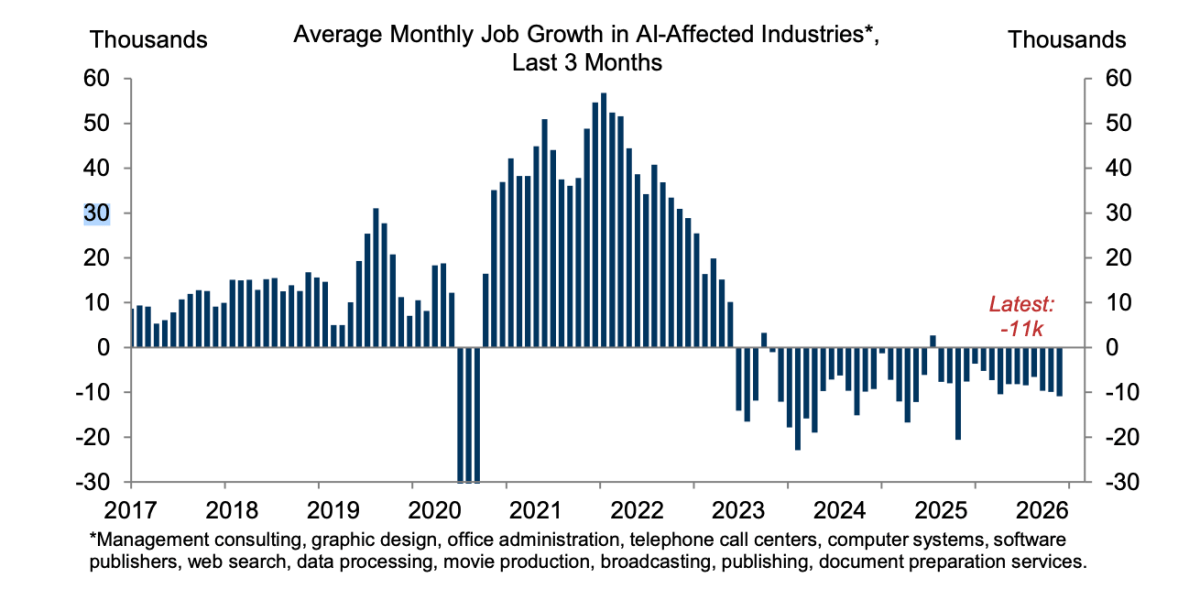
Goldman Sachs economists have updated their AI job displacement tracker, and the numbers are getting worse for the youngest workers in the economy. The bank now estimates that artificial intelligence is wiping out roughly 11,000 net U.S. jobs per month, down from the 16,000 monthly figure they reported in April, but with a catch: the pace of displacement for entry-level white-collar roles is accelerating even as overall job losses slow.
The data tells a demographic story that should alarm anyone under 30. Gen Z workers - those born between 1997 and 2012 - are bearing the brunt of AI-driven job displacement, and Goldman warns the situation is about to get worse. The roles most vulnerable to automation - data entry, customer service, basic content writing, junior coding, and administrative support - are precisely the positions that have traditionally served as on-ramps to professional careers.
This is not the automation story we were told. For years, the conventional wisdom was that AI would displace blue-collar workers first and knowledge workers last. The reality has been the opposite. ChatGPT and Claude can't drive a truck or fix a pipe, but they can write a marketing email, summarize a research report, or generate basic code. The jobs that require a college degree and a laptop are proving easier to automate than the ones that require a wrench and a truck.
The economic implications extend beyond individual job losses. When entry-level roles disappear, the entire career ladder collapses. Junior analysts who would have spent two years learning the fundamentals before being promoted to senior roles now face a market where those junior roles are being absorbed by AI tools. The result is a growing gap between "AI-enhanced" senior workers who can produce five times their previous output and young workers who can't get a foot in the door.
Goldman's research also highlights a regional divide. Cities with high concentrations of tech and finance jobs - San Francisco, New York, Boston, Seattle - are seeing the sharpest declines in entry-level postings. Meanwhile, regions dependent on healthcare, skilled trades, and logistics are seeing relative stability or even growth, reinforcing the irony that the digital economy is now less resilient to AI disruption than the physical economy.
There's a policy dimension too. The federal government's AI initiatives, including recent executive orders on AI safety and workforce development, have focused heavily on retraining programs. But retraining for what? If the jobs being destroyed are the entry points into knowledge work, retraining someone from one at-risk role to another at-risk role doesn't solve the structural problem.
Some economists argue that the solution lies in what they call "AI-proof" career paths - roles that require physical presence, human judgment under uncertainty, or creative problem-solving that AI currently can't replicate. Electricians, nurses, plumbers, and construction managers are seeing wage growth and demand increases even as their office-dwelling peers face contracting opportunities. The message for Gen Z may be counterintuitive: the safest career path in the AI economy might not involve a computer screen.
What This Means For You: If you're a Gen Z worker or a parent of one, the data is clear - the traditional path from college to entry-level office job to career progression is crumbling. Consider dual-track strategies: build AI fluency (prompt engineering, AI tool integration) while also developing skills that require physical presence and human judgment. If you're investing, look at companies that serve the "AI-proof" economy - skilled trade training platforms, healthcare staffing, and infrastructure companies. And if you're a policymaker, the question isn't whether AI will displace young workers - it's already happening. The question is whether we'll build the on-ramps to replace the ones AI destroyed.
Finance & Markets Editor
Originally sourced from Fortune
Related Stories
Young Voters Squeezed by Economy, Distrust in Political System: Poll
A new Harvard Youth Poll paints a sobering picture of the economic and political landscape facing yo...
World shares are mixed and oil prices jump more than 3% after the UAE says it will exit OPEC
World shares are mixed following a retreat on Wall Street, and oil prices gained on Iran war uncerta...
Will the Economy Cost Republicans the Midterms? New Poll Shows Troubling Signs
A new Fox News poll released this week delivers a sobering message for Republicans heading into the ...