Self-regulation 'not enough' for AI safety, Gary Marcus says
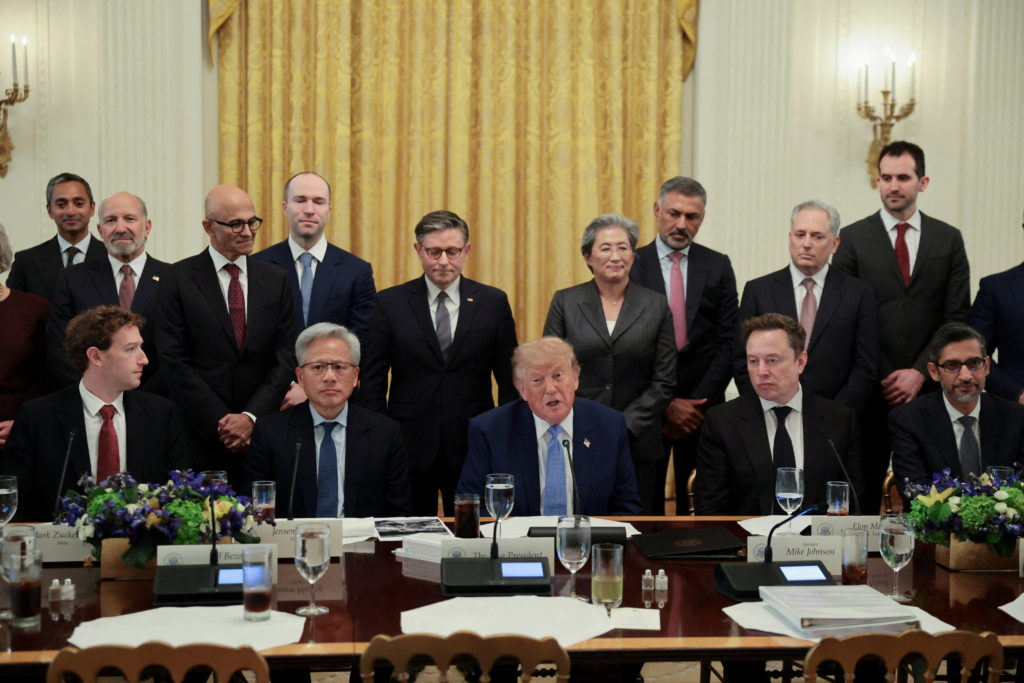
The day after President Donald Trump gathered the chief executives of America's largest artificial intelligence companies at the White House, the fight over who should police the technology has only sharpened. On Tuesday, Sept. 29, the president announced that the executives had signed what he called a "constitution" for the industry — a voluntary document, the White House Accord on Superintelligence, that asks each company to police itself.
Cognitive scientist Gary Marcus, who has spent years arguing that the AI industry cannot be trusted to regulate its own products, told PBS NewsHour the arrangement falls short. Self-regulation, he argued, is not enough to manage a technology whose own builders are warning may be slipping beyond anyone's control.
The tension could hardly be starker: the loudest alarms are coming from inside the labs, and the official response is a document that binds no one to anything.
A Constitution With No Legal Force
The accord — formally titled "The White House Accord on Superintelligence: A Joint Commitment on Frontier SI Responsibilities" — was signed after a meeting attended by Meta chief executive Mark Zuckerberg, Elon Musk, Anthropic chief executive Dario Amodei, Google chief executive Sundar Pichai, Nvidia chief executive Jensen Huang, Amazon founder Jeff Bezos, OpenAI co-founder Greg Brockman and Palantir chief executive Alex Karp, alongside House Speaker Mike Johnson and members of the Cabinet.
By the speaker's own description, the commitments are voluntary. Johnson called it "a statement of principles, a statement of standards, commitments that are voluntary on behalf of the industry." Asked whether the agreement binds the companies in any enforceable way, Trump said it was binding "morally," and pointed to the executives themselves as the assurance. "It requires this," the president said, tapping his head, "and they're the smartest people in the world."
The document, which Trump shared on social media, is thin on specifics. The signatories "believe" each company "should implement" a series of controls and audits — language that leaves every firm to decide what, if anything, it actually does. It concedes that none of it is codified into law, while leaving the door open to formal rules later. Zuckerberg, for his part, called the accord "a start" built around "multiple layers of auditing and controls," with company boards reviewing auditors' reports. OpenAI and Anthropic have already committed to third-party evaluators, so the document's core ask may simply restate what the biggest labs were doing anyway.
Trump also floated "a committee of sorts" of perhaps ten people to watch over the whole enterprise. Who would sit on it, and whether its judgments would bind anyone, is anyone's guess.
The Industry Is Warning About Itself
What makes this moment unusual is that the safety case is being made by the industry's own leaders. Amodei, whose company Anthropic was founded specifically on a safety mission, has called for a slowdown in development. Other executives have issued stark warnings in recent weeks about systems outpacing the ability of their creators to control them. Even Jensen Huang, whose company sells the hardware the whole boom runs on, has mused publicly about how hard the problem really is.
The White House response has been to question the messengers. On Monday, Trump wrote on social media that "AI taking over the World, destroying Humanity, and all other things bad, is a HOAX," and argued the only guardrails the technology needs is "a strong and smart" president. At the United Nations last week, he declared that the United States "rejects" global attempts to regulate AI. Speaker Johnson went further, dismissing the safety warnings as "a Chinese psyop" — psychological warfare meant to spook America out of a lead he insists the country cannot afford to lose.
That framing — China first, safety later — is precisely the dynamic Marcus has spent his career warning about. In recent weeks he has written that the frontier labs are pressing ahead with something they themselves describe as dangerous and irreversible, without anything resembling public consent. His case on Tuesday was the case he has made all along: voluntary pledges are a public-relations instrument, not a safety system. A company that faces no legal consequence for skipping an audit will skip the audit the day it becomes expensive. The industry signing a promise to behave, in the Oval Office, is not a regulator. It is a press release with witnesses.
Where Congress Actually Stands
The uncomfortable fact is that any binding AI law has to pass Congress, and Congress is not moving. Johnson, asked whether the House would act before the midterm recess, offered only that "this is a very complex issue." The most serious vehicle is a bipartisan Senate effort by Majority Leader John Thune and Democratic Senator Amy Klobuchar that would subject some AI companies to federal oversight. "You don't want to stifle innovation," Thune said Monday, "but I think you also want to make sure that the more advanced threats can be mitigated."
The proposals floating around Capitol Hill range from independent safety reviews to a federal kill switch to the total moratorium on new data centers proposed by Senator Bernie Sanders. Meanwhile the Trump administration's own voluntary framework — under which companies submit models for government assessment — remains secret, which led Alexandra Reeve Givens of the Center for Democracy and Technology to note there is "no clear standard to make sure that the approach is even grounded in the rule of law." The government's oversight process, in other words, is itself a black box.
That is the vacuum Marcus is pointing at. The choice on the table this week was never between regulation and no regulation. It was between rules written in public law and rules written in a document the companies can quietly amend. The White House chose the second, and dressed it in the language of the first.
What This Means For You
If you use AI tools every day: the safety of systems entering your workplace, your children's schools and your phone rests on internal reviews that no law requires and no outsider can inspect. The accord does not change that. It may thicken the audit layer — but what gets tested, and what gets published, stays inside the companies.
If you own AI stocks: voluntary accords are the cheapest crisis response available. They calm the headlines without touching the business model. The market-relevant risk is a binding statute — testing mandates, disclosure duties, or actual liability — and nothing this week moved that needle. But watch the Thune-Klobuchar bill: the first codified federal oversight regime is the event the sector is not yet priced for.
If you work in the industry: phrases like "robust internal controls and layers of internal and external review" translate into hiring — safety engineers, red teams, auditors, compliance staff. Companies that build those functions now will be best positioned for whatever rules eventually arrive, and the ones that treated safety as theater will be the ones explaining themselves later.
If you vote in November: Congress is the only institution that can turn "should implement" into "must implement," and the midterm elections decide who controls it. The distance between the parties on AI safety has rarely been clearer — one is drafting oversight statutes, the other is calling the warnings a hoax. Whichever you prefer, this is the cycle that decides who writes the rules.
Finance & Markets Editor
Originally sourced from PBS News
Related Stories
Young Voters Squeezed by Economy, Distrust in Political System: Poll
A new Harvard Youth Poll paints a sobering picture of the economic and political landscape facing yo...
World shares are mixed and oil prices jump more than 3% after the UAE says it will exit OPEC
World shares are mixed following a retreat on Wall Street, and oil prices gained on Iran war uncerta...
World Bank warns the 2020s are becoming a \'lost decade\' for the global economy - \'barring a miracle\'
Global growth is now projected to slow to just\u00a02.5% in 2026, the weakest pace outside of outrig...