The rare Ebola outbreak is one danger. Attacks on healthcare workers are another
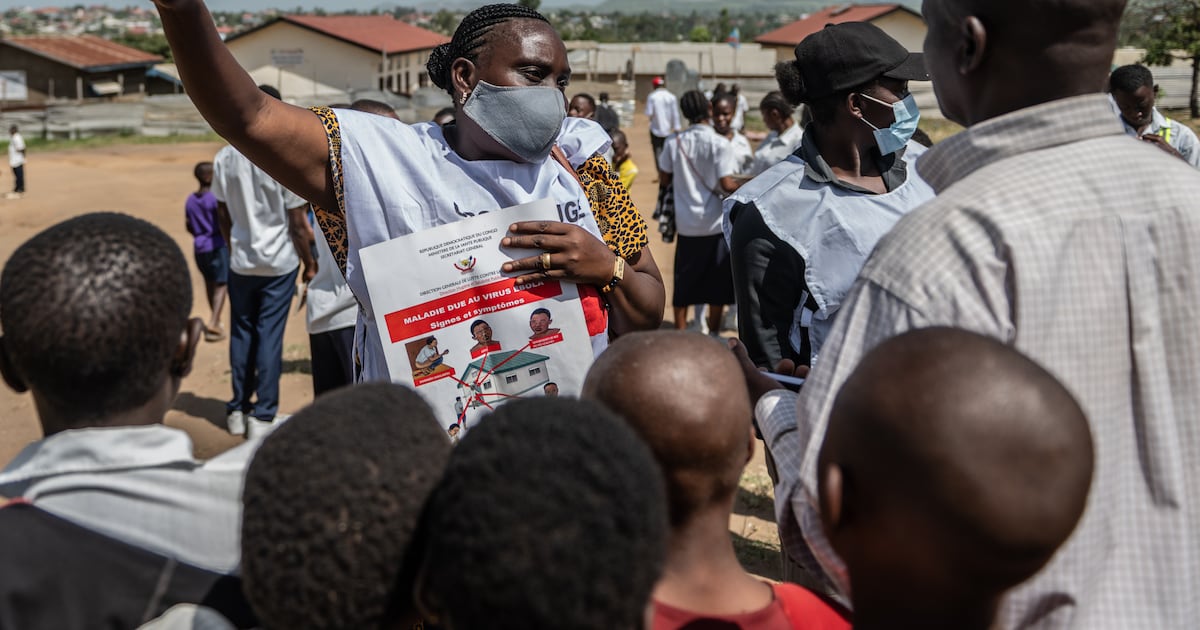
Eastern Congo is facing two simultaneous catastrophes, and neither is getting the attention it deserves. A rare strain of Ebola is spreading toward 1,000 cases, while the healthcare workers trying to stop it are being attacked by the communities they are trying to save.
Three times in the past week, healthcare facilities treating Ebola patients have been assaulted. On Sunday, angry young men stormed a hospital, forcing medical staff to evacuate patients as gunfire rang out. On Saturday, residents set fire to a Doctors Without Borders treatment tent in Mongbwalu, causing more than a dozen suspected Ebola patients to flee into the community. On Thursday, a health center in Rwampara was burned to the ground after relatives were barred from retrieving the body of a man suspected to have died from the virus.
The message from the community is clear: they would rather face Ebola than the people who claim to be fighting it.
## The Outbreak by the Numbers
World Health Organization Director-General Tedros Adhanom Ghebreyesus confirmed Monday that the outbreak has surpassed 900 suspected cases and more than 220 suspected deaths. Both the WHO and Africa Centers for Disease Control and Prevention believe the true toll is higher than reported figures.
This is the Bundibugyo strain of Ebola — rarer and less studied than the Zaire strain that devastated West Africa in 2014-2016. Early tests in this outbreak were mistakenly conducted for the more common Ebola type, costing valuable response time. Experts are still trying to determine when the outbreak actually began.
If confirmed reports from the International Federation of Red Cross and Red Crescent Societies are accurate, the timeline may stretch back significantly further. Three Red Cross volunteers died in Mongbwalu on March 27 during work unrelated to Ebola — but their deaths, potentially from Ebola contracted through body handling, would push the start date back by weeks before the first confirmed case.
## Why Communities Are Burning Down the Clinics
The attacks on health facilities are not random violence. They are rooted in a devastating collision of culture, distrust, and failed communication.
Ebola prevention protocols require that bodies of the deceased be handled by trained medical staff in protective equipment, not by grieving families. In a region where burial rites are sacred and communal, this medical necessity is experienced as a profound violation. Loved ones die alone behind plastic barriers, and their bodies are taken away by strangers in hazmat suits.
Heather Kerr, Congo country director for the International Rescue Committee, put it plainly: 'Trust is almost as important as the health response, because if you get this massive distrust in the communities, they're not going to go to the health centers.'
Some residents do not even believe Ebola exists. Action Aid, one of the humanitarian groups responding, reported that a high level of skepticism persists in Ituri province. When people see healthcare workers dying from the same disease they claim to be fighting, the suspicion deepens. At least one Congolese doctor has died. Three health workers in neighboring Uganda have been infected. The Red Cross volunteers may have been among the earliest casualties.
Mado Nditamba, a 70-year-old Bunia resident, captured the despair: 'The last time Ebola came, it was not on the scale that we see today. But this epidemic today is worse. We go to the doctors in the hospitals, but they also die. That's what worries us. We don't know what to do and we leave everything to God.'
## The Geography of Failure
Eastern Congo presents obstacles that would challenge any outbreak response. The affected region is more than 1,000 kilometers from the national capital, Kinshasa. Travel between towns like Bunia and Mongbwalu requires navigating active conflict zones where armed groups operate freely.
The region's main humanitarian airport has been in rebel hands for over a year. Clinics run on generators, if they run at all. Testing capacity for the Bundibugyo strain is limited to a few facilities, creating delays of days between sample collection and diagnosis.
This is not the first Ebola outbreak in Congo — it is the country's 17th. The WHO says Congo is equipped to respond. The evidence on the ground suggests that capacity has been overwhelmed.
## Why This Outbreak Matters Beyond Congo
The case count is doubling. Suspected cases have already appeared in neighboring Uganda. The US has added Ebola screening at its busiest airports. The WHO has convened emergency meetings.
But the deeper concern is structural. The same conditions that make this outbreak hard to contain — conflict zones, community distrust, inadequate health infrastructure, delayed detection — exist in multiple regions where emerging pathogens could spark the next global health crisis.
Yakubu Mohammed Saani, Action Aid's Congo country director, identified the only path forward: 'The only way to go, as far as this particular virus is concerned, is community engagement.' Building that trust takes time, staff, and cultural competence that international organizations have repeatedly failed to deliver.
## What This Means For You
An Ebola outbreak in eastern Congo may feel remote, but the conditions that make it uncontainable are relevant to every global health conversation — and to your own preparedness.
**Global health security is only as strong as its weakest link.** A pathogen that reaches 1,000 cases in a conflict zone with limited surveillance and community resistance is a pathogen that can spread. The 2014-2016 West Africa Ebola outbreak started in similar conditions and eventually reached the United States.
**Community trust determines outbreak outcomes.** The lesson from Congo applies everywhere: if people do not trust the institutions responding to a crisis, they will not cooperate with testing, isolation, or treatment. This is true in Congo and it was true during COVID in the US. Public health is fundamentally a trust enterprise.
**Know your own health system's capacity.** The CDC is monitoring this outbreak. If you live near a major international airport, ask yourself: does your local hospital have isolation capacity? Does your state have a public health infrastructure that could handle an infectious disease surge? Most Americans would be surprised at how thin that infrastructure is.
**Pay attention to travel advisories.** The US has already implemented Ebola screening at major airports. If you are traveling to or from East Africa, check CDC advisories before and after your trip. The incubation period for Ebola can be up to 21 days.
Editorial Team
Originally sourced from The Atlanta Journal-Constitution
Related Stories
Juvenile Shot in Vehicle Incident in Randolph County Highlights Gun Safety Concerns
COLUMBIA, Mo. (KMIZ) A juvenile had non-life-threatening injuries after they were accidentally shot ...
Your Android Camera Can Do Much More Than Take Photos — Here\'s What You\'re Missing
With the right apps, your Android camera becomes a health monitor, food scanner, accessibility tool,...
Young country music star's scary condition can kill her instantly: 'You're just gone'
The 28-year-old has been open about her health diagnosis....