$880bn for chips and robots
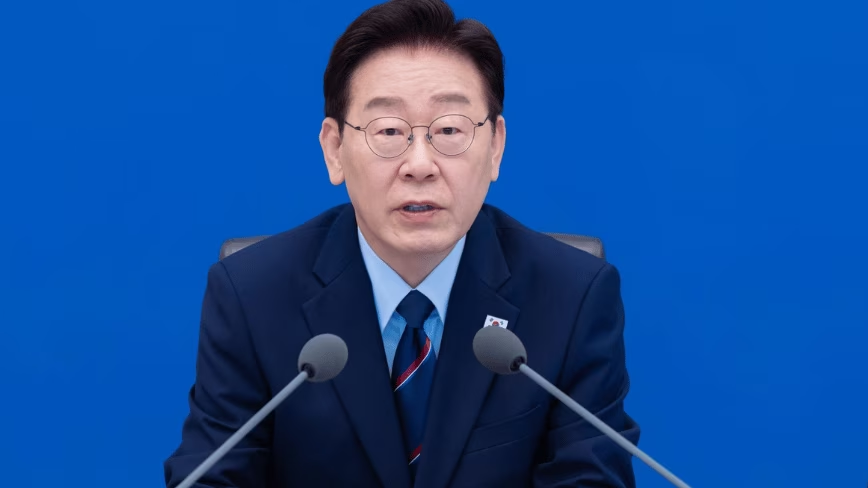
South Korea just placed the biggest bet in the global AI arms race — and it's not even close.
President Lee Jae Myung stood in Seoul on Monday flanked by the heads of Samsung and SK Hynix, the two companies that dominate the world's memory chip market, and announced a commitment of at least 1.2 quadrillion won — roughly billion — over the next decade to build out South Korea's AI infrastructure. The scope is staggering: new semiconductor fabrication plants, 18.4 gigawatts of data center capacity, and a nationwide push into robotics that aims to make South Korea one of the top three AI economies in the world.
Lee didn't mince words about the urgency. He called Samsung chairman Lee Jae-yong and SK Hynix CEO Kwak Noh-jung "national heroes" and framed the spending package as nothing less than a matter of national survival. "Speed is now the only way to survive," he said, according to prepared remarks.
The plan breaks down into three major pillars. First, the semiconductor buildout. South Korea currently produces roughly 60% of the world's DRAM and 70% of its high-bandwidth memory — the specialized chips that go into AI accelerators. The new commitment includes subsidies and tax incentives for additional fabrication capacity, with the goal of maintaining South Korea's dominance even as the United States, Japan, and the European Union all pour hundreds of billions into their own chip programs.
Second, the data center expansion. The 18.4-gigawatt target is enormous — roughly equivalent to the current total data center capacity of the entire United States. South Korea's geographic advantages are real: relatively mild climate reduces cooling costs, existing undersea cable infrastructure provides low-latency connectivity to both North America and Asia-Pacific markets, and a regulatory environment that has historically been friendly to large infrastructure projects.
Third, robotics. South Korea already has one of the highest robot densities in manufacturing globally, but the new plan envisions a dramatic expansion into service robotics, healthcare robotics, and agricultural automation. The government is creating a dedicated robotics investment fund and streamlining regulatory approvals for autonomous systems — a sharp contrast to the more cautious approach in many Western economies.
The geopolitical context makes this more than just an industrial policy announcement. Taiwan's TSMC produces over 90% of the world's most advanced chips, and the vulnerability of that concentration has been a central concern for governments worldwide since COVID exposed the fragility of global supply chains. South Korea's move can be read as both an attempt to capitalize on that anxiety and a hedge against Chinese competition — Beijing has its own massive chip investment program, though it's been hampered by US export controls on advanced equipment.
For the United States, the South Korean announcement is both encouraging and uncomfortable. The CHIPS Act committed billion to domestic semiconductor production, a figure that now looks modest against not just South Korea's commitment but also the combined spending of China, Japan, and the EU. American companies like Nvidia and AMD stand to benefit from expanded global capacity, but the strategic question of where the most advanced chips are physically made remains unresolved.
The market reaction was swift. Samsung Electronics rose 4.2% on the news. SK Hynix gained 3.8%. The broader KOSPI added 1.7%. In the US, semiconductor equipment manufacturers like Applied Materials and Lam Research also moved higher on expectations of increased orders.
But there are risks. South Korea's demographic trajectory — with a fertility rate below 0.8, the lowest in the developed world — raises real questions about who will staff these facilities. The plan includes provisions for increased immigration of skilled workers and expanded automation within the fabs themselves, but the labor shortage problem is structural and worsening.
Environmental concerns are also mounting. The energy consumption of 18.4 GW of data centers is enormous, and South Korea's current grid already struggles during peak summer demand. The plan includes investments in nuclear and renewable energy, but the timeline for bringing that capacity online is years behind the data center buildout schedule.
What This Means For You: The billion South Korean commitment is going to reshape the technology landscape you interact with daily. In the short term, it means more chip supply should eventually ease the price pressure on electronics — but not for at least 3-5 years. In the meantime, if you work in semiconductors, data center operations, or robotics engineering, your skills just became even more valuable globally. And if you're invested in the semiconductor supply chain — from equipment makers to chip designers — this is a multi-year tailwind. The AI infrastructure race is no longer just a Silicon Valley story. It's a national competition, and South Korea just raised the stakes for everyone.
Editorial Team
Originally sourced from TNW
Related Stories
YouTube is testing an AI search mode that \'feels more like a conversation\'
A new feature called Ask YouTube will let you pose complex questions and receive...
YouTube is testing an AI-powered search feature that shows guided answers
YouTube is rolling out the new AI search feature to Premium subscribers in the U.S. on an opt-in bas...
YouTube is giving creators a new weapon against AI deepfakes
YouTube is rolling out a new AI safety feature that could help creators spot deepfake-style videos u...