AI Demand, War, & Climate Pressure Push World Back To Nuclear
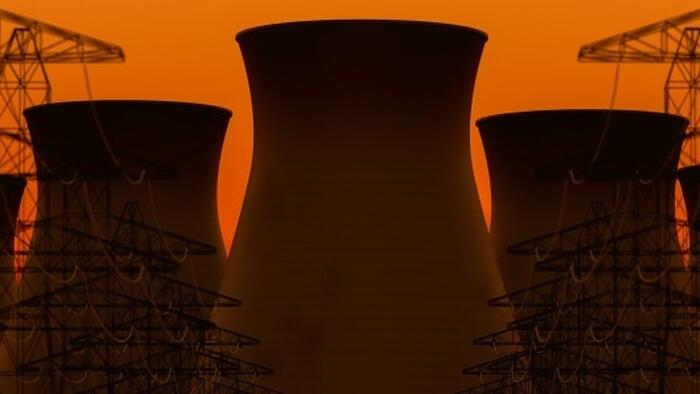
In the span of one week, both the United States and Canada announced plans to build ten new nuclear reactors each — the most significant coordinated nuclear expansion North America has seen in decades. The twin announcements reflect a global shift that would have seemed improbable just five years ago: nuclear energy, long marginalized after Chernobyl and Fukushima, is being embraced as an essential pillar of energy security in an era defined by AI-driven demand, geopolitical instability, and accelerating climate pressures.
The force pushing the world back toward nuclear is not one crisis but three converging at once. First, the AI boom is driving unprecedented electricity demand. Data centers — which already consume roughly 2 percent of global electricity — are expanding at a pace that existing grids cannot support. Every major tech company has identified power supply as a binding constraint on growth, and nuclear's ability to deliver zero-carbon, round-the-clock baseload power makes it uniquely suited to the problem.
Second, the war in Iran and broader Middle Eastern instability have underscored the fragility of energy supply chains dependent on oil and gas from volatile regions. The conflict has sent periodic shockwaves through energy markets, reminding governments that energy independence is not an abstraction — it is a national security imperative. Nuclear plants, once built, produce power regardless of what happens to shipping lanes in the Strait of Hormuz.
Third, the climate math remains stubborn. The world needs to halve emissions by 2030 and reach net zero by 2050, and no credible pathway exists without substantial nuclear capacity. Solar and wind are growing faster than ever, but they remain intermittent. Batteries help, but grid-scale storage at the duration needed — days, not hours — remains expensive and scarce. Nuclear fills the gap that renewables cannot.
Canada's move is particularly notable. Energy Minister Tim Hodgson framed the country's nuclear push as essential to doubling the national grid by 2050. "If our goal is to double our grid and build a low-carbon economy in less than 25 years, there is no credible plan to do that without nuclear energy and the clean, reliable baseload power it provides," Hodgson said at a press conference in Ontario. The Canadian plan positions nuclear as a core component of a broader strategy to establish the country as an energy superpower.
The United States is pursuing a parallel track. The Trump administration announced a plan to channel billions in federal loans toward jumpstarting nuclear construction, with utilities required to put forward hundreds of millions of their own capital to access the federal backing. The approach is designed to ease the sticker shock of building large new reactors, which has historically run into billions in cost overruns.
The scale of the catch-up required is staggering. Over the past decade, China has added 34 gigawatts of nuclear capacity. The United States has built one new plant — years late and billions over budget. China is now on track to overtake both the US and France as the world's largest nuclear power producer within the next decade. For Western governments, the nuclear renaissance is not just about climate or AI; it is about not falling further behind in a technology race with enormous geopolitical implications.
The challenges remain real. Nuclear construction in the West has a terrible track record of delivering on time and on budget. Regulatory hurdles, supply chain constraints, and a depleted workforce of nuclear engineers all stand in the way. But the political and economic conditions that sidelined nuclear for a generation have fundamentally changed. The question is no longer whether nuclear will expand, but how fast and at what cost.
What This Means For You: The nuclear revival is not just an energy story — it is an investment, employment, and infrastructure story. If you work in construction, engineering, or grid infrastructure, the next decade will bring thousands of new jobs as reactor projects break ground. If you invest, companies in nuclear construction, uranium mining, and grid-scale energy storage are positioned at the intersection of three megatrends: AI demand, energy security, and decarbonization. And if you simply pay an electric bill, the bet your government is making is that nuclear will deliver stable, affordable power decades from now — but the costs and construction timelines will be borne by ratepayers and taxpayers first. Watch who wins the contracts, where the plants get built, and whether the industry can finally execute on time and on budget. That will determine whether the nuclear renaissance is real or another false start.
Editorial Team
Originally sourced from ZeroHedge
Related Stories
YouTube is testing an AI search mode that \'feels more like a conversation\'
A new feature called Ask YouTube will let you pose complex questions and receive...
YouTube is testing an AI-powered search feature that shows guided answers
YouTube is rolling out the new AI search feature to Premium subscribers in the U.S. on an opt-in bas...
YouTube is giving creators a new weapon against AI deepfakes
YouTube is rolling out a new AI safety feature that could help creators spot deepfake-style videos u...